Singapore Business Visa

Offshore services
Bundled Services
Top Citizenship & Residency
Articles & Research
About Us
Contact Us


Trusted by Global Clients & Partners
September 24, 2026
6
聽min read

Vanuatu Citizenship by Investment 2026: Cost, Routes, Timeline


5.9K

5.9K
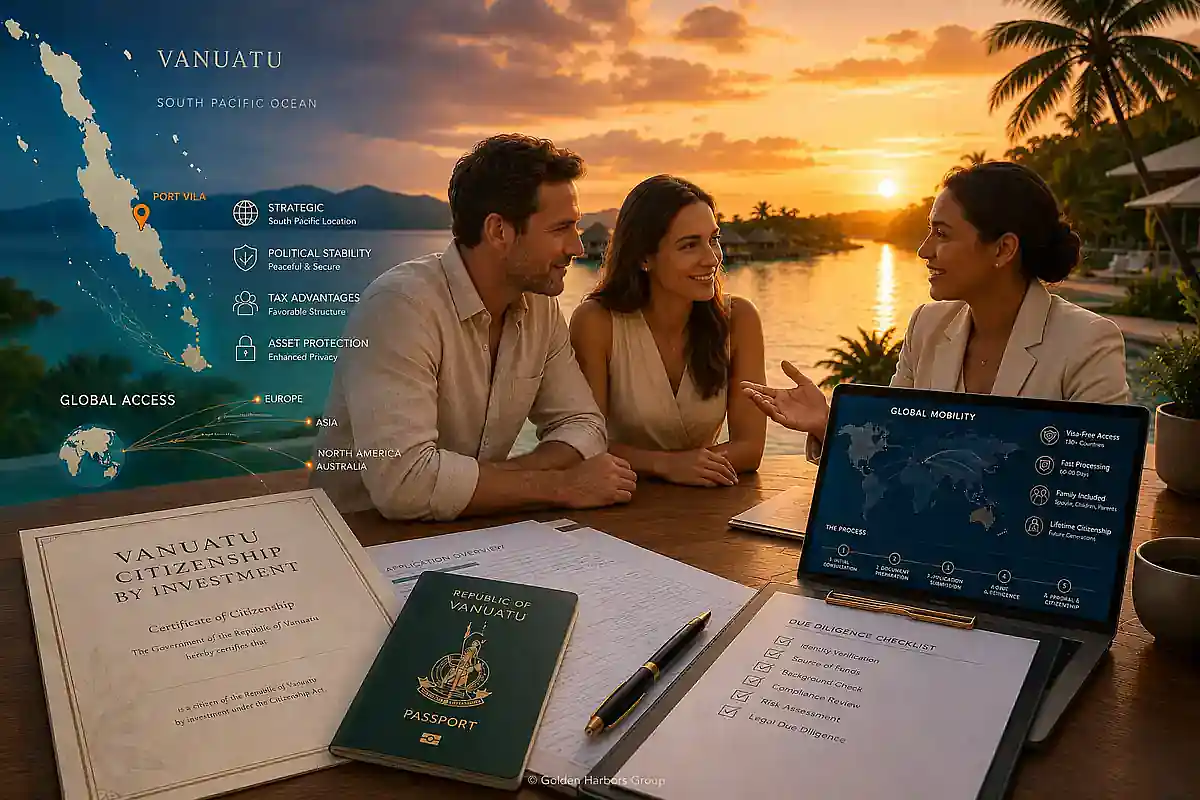
Vanuatu citizenship by investment is the world's fastest second-passport route: a non-refundable USD 130,000 contribution to the Development Support Program under Citizenship Act CAP.112 delivers citizenship in roughly 30 to 60 days, with no residency, language, or interview requirement beyond a mandatory in-person biometric submission introduced in 2025.
Key Takeaways
- Minimum investment is USD 130,000 (non-refundable) under the Development Support Program for a single applicant, rising to USD 180,000 for a family of four.
- Approval in principle typically arrives within of complete submission. End-to-end timelines run 2 to 4 months once biometrics and passport issuance are included.
- All applicants 16 and older must submit biometrics in Vanuatu or at an overseas mission (Dubai, Hong Kong, Noumea), mandatory since 2025.
- The European Council Schengen visa-free access for Vanuatu passport holders on December 12, 2024. The UK also requires a visa.
- Dual citizenship has been permitted since the , and Vanuatu levies no personal income, capital gains, inheritance, or wealth tax.
Quick Facts: Vanuatu Citizenship by Investment 2026
Minimum investment (DSP, single): USD 130,000
DSP, family of four: USD 180,000
CIIP alternative: USD 165,000 with USD 50,000 redeemable
Real Estate Option: from USD 200,000 in approved projects
Due diligence fee: USD 5,500 (DSP), USD 8,000 (CIIP)
Asset proof required: USD 250,000
Processing time: 30 to 60 days approval; 2 to 4 months end-to-end
Passport mobility: approx 88 destinations (2026)
Weighing Vanuatu against a Caribbean passport that keeps Schengen and UK access? Book a consultation with 91AV原创 to map the route to your mobility and tax priorities.
What Is the Vanuatu Citizenship by Investment Program?
The Vanuatu CBI program is one of the world's fastest legal pathways to a second passport. It is administered by the Vanuatu Citizenship Office and Commission (VCC) under the legal framework of the , the Citizenship Amendment Act of 2013 (which legalized dual citizenship), and the Development Support Program Regulation of 2017.
The program operates through three legal investment routes for the global market: the Development Support Program (DSP), launched in 2017; the Capital Investment Immigration Plan (CIIP), introduced in 2020 and refined under later amendments; and the Real Estate Option (REO), formalized under Regulation Order No. 93 of 2021 and ratified for commencement on November 28, 2024. A fourth route, the Vanuatu Contribution Program (VCP), is marketed primarily to Chinese applicants.
The CIIP was briefly suspended on March 17, 2025 for a 100-day regulatory overhaul to tighten due diligence, then reopened in May 2025 with a refocus on impact funds. The DSP was not suspended and has run continuously since 2017, which is why it remains the most established and most widely used route as of 2026.
Vanuatu, an archipelago of approximately 80 islands in the South Pacific east of Australia and west of Fiji, is the only major non-Caribbean and non-Mediterranean CBI jurisdiction. The country gained independence from Anglo-French Condominium administration in 1980 and operates as a parliamentary republic with English, French, and Bislama as official languages.
Oversight is shared across three institutions. The Vanuatu Citizenship Office (VCO) handles operational application processing, document verification, and certificate issuance. The Vanuatu Citizenship Commission (VCC) reviews and approves applications at the discretion of the Government of Vanuatu. The conducts independent due diligence through international vendor partnerships.
The CBI program is economically central to Vanuatu: preliminary Ministry of Finance data put citizenship revenue at approximately USD 97 million in the first half of 2026, about 39% of total government revenue. That dependence makes the program both durable and exposed to external regulatory pressure. The December 2024 EU Schengen visa-waiver termination is the most consequential example of that exposure to date.
What Are the Key Benefits of Vanuatu Citizenship by Investment?
For high-net-worth investors weighing Vanuatu CBI against alternatives, six benefits drive demand in 2026.
Speed unmatched in the global CBI market. Approval in principle is routinely issued within 30 to 60 days of complete submission. End-to-end timelines from initial engagement to passport delivery typically land between 2 and 4 months. No other credible CBI program operates in this window in 2026. Caribbean CBI now runs 4 to 6 months under the OECS framework, Malta MEIN runs 12 to 36 months, and Turkiye CBI runs 6 to 12 months.
Zero tax on personal income, capital gains, inheritance, wealth, and gifts. Vanuatu operates a tax-neutral system financed primarily through VAT (currently 15%) and customs duties. There is no domestic tax exposure for Vanuatu citizens who do not become tax-resident in the country.
No residency, language, or interview requirement. Beyond the in-person biometric submission introduced in 2025, the application process is fully remote. Applicants do not need to visit Vanuatu before or during the application, and there is no language test, civics exam, or formal interview.
Comprehensive family inclusion. The principal applicant can include a spouse, dependent children up to age 25, and financially dependent parents over 50 on the same application. Additional dependents (siblings, adult children, grandparents) can be added subject to enhanced fees and due diligence.
Dual citizenship permitted. The Citizenship Amendment Act of 2013 permits dual and multiple citizenship without restriction. Vanuatu does not require applicants to renounce existing nationalities.
Lower cost than every other major CBI program. The USD 130,000 DSP entry point for a single applicant is the lowest of any active CBI program in 2026. Saint Kitts SISC starts at USD 250,000 for a family of 4, Dominica EDF at USD 200,000, Grenada NTF at USD 235,000, and Antigua NDF at USD 230,000.
What Are the Investment Routes for Vanuatu CBI in 2026?
The program is administered by the (VCC) and overseen by the Financial Intelligence Unit (FIU). Three legal routes serve the global market in 2026.
The Development Support Program (DSP)
Non-refundable contribution to the National Development Fund. The most widely used route, with the most standardized timeline and document set, and the only route never suspended. Pricing scales per family member, with the principal applicant at USD 130,000.
The Capital Investment Immigration Plan (CIIP)
A fixed USD 165,000 contribution covering applicants and dependents up to a family of four, with USD 50,000 allocated to the CNO Future Fund (also referred to as the Cocoa and Coconut Sustainable Fund, linked to Vanuatu's cocoa and coconut sectors) and redeemable after 4 to 5 years. Lower net cost for larger families. Higher due diligence fee at USD 8,000. Suspended March to May 2025 and reopened with a refreshed impact-fund focus.
The Real Estate Option (REO)
Investment of at least USD 200,000 in , currently including Pacific Springs, Narpow Point Coral Bay, FPF Rainbow City on Efate, and Milai on Espiritu Santo. Used by a small minority of applicants. Project selection is narrow and adds title-transfer complexity.
For most applicants, the DSP is the cleanest path. 91AV原创 recommends the CIIP only for families of three or four where the redeemable component meaningfully changes the net cost calculus. The REO suits applicants who specifically want a Pacific real-estate position alongside the passport.
| Dimension | DSP | CIIP | REO |
|---|---|---|---|
| Minimum investment | USD 130,000 | USD 165,000 | USD 200,000 |
| Family pricing | Scales per dependent | Flat for 1 to 4 applicants | Scales per dependent |
| Refundable component | None | USD 50,000 redeemable after 4 to 5 years via CNO Future Fund | Property resale possible after 5-year hold |
| Due diligence fee | USD 5,500 | USD 8,000 | USD 5,500 |
| Available since | 2017 | 2020 | 2024 (commencement) |
| Project or vehicle | National Development Fund | CNO Future Fund (cocoa and coconut sectors) | 4 approved developments on Efate and Espiritu Santo |
| Best fit | Single applicants and families seeking lowest entry cost | Families of 3 to 4 wanting partial capital recovery | Investors seeking Pacific real estate exposure |
| Sources: Vanuatu Citizenship Office and Commission, Citizenship Act CAP.112, Development Support Program Regulation 2017, Capital Investment Immigration Plan framework, Real Estate Option Regulation Order No. 93 of 2021. Figures current as of September 2026. CIIP redemption is conditional on CNO Future Fund performance and program terms in effect at the time of redemption. | |||
What Does Vanuatu Citizenship by Investment Cost in 2026?
The tables below show the full all-in cost by family composition for each route. Figures are current as of September 2026. For a detailed per-applicant cost breakdown across all routes, see our standalone Vanuatu citizenship cost reference.
DSP Cost Breakdown by Family Size
← Swipe →
| Cost Component | Single Applicant | Family of 2 | Family of 3 | Family of 4 |
|---|---|---|---|---|
| Non-refundable contribution | USD 130,000 | USD 150,000 | USD 165,000 | USD 180,000 |
| Government due diligence fees | USD 5,500 | |||
| Citizenship certificate | USD 200 | USD 400 | USD 600 | USD 800 |
| Passport issuance | USD 800 | USD 1,600 | USD 2,400 | USD 3,200 |
| Biometric submission | from USD 1,000 per person, location-dependent | |||
| Bank fees | USD 500 | |||
| Professional advisory fees | from USD 5,000 | |||
| Source: Vanuatu Citizenship Office and Commission, Citizenship Act CAP.112. Due diligence fee and biometric framework reflect 2025 government updates. Biometric submission fees vary by enrollment location. | ||||
Each additional dependent beyond the fourth incurs an extra USD 15,000 on the contribution. Applicants must demonstrate proof of at least USD 250,000 in personal assets to meet the financial eligibility threshold.
CIIP Cost Breakdown by Family Size
← Swipe →
| Cost Component | Single Applicant | Family of 2 | Family of 3 | Family of 4 |
|---|---|---|---|---|
| Contribution (USD 50,000 redeemable after 4 to 5 years) | USD 165,000 flat for 1 to 4 applicants, plus USD 25,000 per dependent from the 5th | |||
| Government due diligence fees | USD 8,000 | |||
| Citizenship certificate | USD 200 | USD 400 | USD 600 | USD 800 |
| Passport issuance | USD 800 | USD 1,600 | USD 2,400 | USD 3,200 |
| Biometric submission | from USD 1,000 per person, location-dependent | |||
| Bank fees | USD 700 | |||
| Professional advisory fees | from USD 5,000 | |||
| Source: Vanuatu Citizenship Office, Capital Investment Immigration Plan framework. CIIP redemption is conditional on CNO Future Fund performance and program terms in effect at the time of redemption. | ||||
The redeemable USD 50,000 is held by the , a government-approved vehicle linked to Vanuatu's cocoa and coconut sectors. Net cost after redemption is approximately USD 115,000 to USD 130,000 depending on family composition, lower than DSP for families of three or four.
REO Cost Breakdown by Family Size
← Swipe →
| Cost Component | Single Applicant | Family of 2 | Family of 3 | Family of 4 |
|---|---|---|---|---|
| Real estate investment | USD 200,000 | USD 215,000 | USD 230,000 | USD 230,000 |
| Government due diligence fees | USD 5,500 | |||
| Citizenship certificate | USD 200 | USD 400 | USD 600 | USD 800 |
| Passport issuance | USD 800 | USD 1,600 | USD 2,400 | USD 3,200 |
| Biometric submission | from USD 1,000 per person, location-dependent | |||
| Bank fees | USD 1,500 | |||
| Professional advisory fees | from USD 10,000 | |||
| Source: Vanuatu Citizenship Office, Real Estate Option Program Regulation Order No. 93 of 2021, ratified for commencement November 28, 2024. Approved projects on Efate and Espiritu Santo. Property held minimum 5 years before resale. | ||||
The real estate is held for a before resale. Approved projects are concentrated on Efate and Espiritu Santo, the two largest islands.
Who Qualifies for Vanuatu Citizenship by Investment?
To qualify for any Vanuatu CBI route, applicants must meet six core requirements.
- Clean criminal record. Police clearance from every country the applicant has lived in for 12 months or more within the past 10 years.
- Proof of source of funds. Bank statements, business records, or audit-traceable documentation showing the legal origin of the investment funds.
- Asset proof of USD 250,000. Bank reference letter or asset report confirming the threshold is met.
- Health clearance. Medical certificate confirming the applicant and dependents are free of serious contagious diseases.
- Age threshold. Principal applicant must be at least 18. No upper age limit. Dependents 16 and over face full due diligence.
- No prior visa or citizenship refusals from countries with which Vanuatu maintains visa-free or visa-on-arrival arrangements, unless subsequently approved.
Applications from nationals of (currently including Iran, Iraq, North Korea, Syria, and Yemen) are subject to enhanced restrictions and may be declined regardless of merit. Direct applications are not accepted. All files are submitted through a licensed designated agent.
How Does the Vanuatu CBI Application Process Work?
Step 1. Preliminary Background Check and Pre-Approval (1 to 3 Days)
A certified Anti-Money Laundering officer runs an initial background check against international databases. The applicant provides a passport copy and a basic questionnaire. Pre-approval signals that the file can proceed.
Step 2. Document Preparation and Submission (2 to 4 Weeks)
The applicant assembles the full document set: nomination form, certified passport copies, police clearances, asset report, medical certificate, six passport photos, and the supporting financial evidence. Documents must be certified and, where not originally in English, translated by a sworn translator.
Step 3. Financial Intelligence Unit Due Diligence (3 to 8 Working Days)
The runs a full background check against domestic and international databases. Most files complete this stage in 3 to 4 working days. The output is either a green light for citizenship approval or a refusal with no appeal.
Step 4. Approval in Principle and Investment Payment (Within 90 Days of Approval)
On positive FIU clearance, the Citizenship Commission issues approval in principle. The applicant has 90 days to wire the contribution (DSP), CIIP allocation, or close on the real estate transaction.
Step 5. Biometric Submission (In Person, Mandatory)
Every applicant aged 16 and over submits biometrics in person. Approved locations include Port Vila and Vanuatu diplomatic missions in Dubai, Hong Kong, and Noumea. A consul can be dispatched to a third location at additional cost.
Step 6. Naturalization Certificate, Citizenship, and Passport Issuance (2 to 4 Weeks)
On confirmation of payment and biometric capture, the Commission issues the naturalization certificate, ID card, and biometric e-passport. Birth certificates and ID cards became mandatory deliverables in 2025 at a per-person fee starting at USD 1,000.
What Documents Are Required for a Vanuatu CBI Application?
The Vanuatu Citizenship Office requires the following documents from every principal applicant and from each dependent aged 16 and over. Document gaps and apostille delays are the single most common cause of timeline slippage.
Personal identity documents:
- Certified copy of current passport (every applicant)
- Certified copy of national ID card (every applicant)
- 6 recent passport-sized photographs (white background, biometric specification)
- Certified copy of birth certificate (every applicant)
- Certified copy of marriage certificate (if applicable)
- Certified copy of any divorce decree or death certificate ending a prior marriage (if applicable)
Background and clearance documents:
- Police clearance certificate from every country where the applicant has lived 12 months or more in the past 10 years
- Medical certificate confirming no serious contagious diseases (issued within 90 days of submission)
- Curriculum vitae and personal profile in narrative form
- Affidavit of full disclosure of any prior visa or citizenship refusals
Financial documents:
- Bank reference letter confirming relationship and standing
- Asset report or financial statement demonstrating USD 250,000 in net assets
- Source-of-funds documentation showing the legal origin of the investment funds (bank statements, business records, tax returns, audit trail)
- Bank statements for the prior 6 months across all personal and business accounts
Format requirements:
- All non-English documents must be translated by a sworn or certified translator
- All documents must be apostilled or notarized under the Hague Convention for international use
- All certified copies must be issued by a licensed notary public, lawyer, or designated agent
The full document package typically runs 80 to 120 pages for a single applicant and 200 to 400 pages for a family of 4. Document preparation alone takes 2 to 4 weeks for most applicants.
How Strong Is the Vanuatu Passport in 2026?
The Vanuatu passport delivers visa-free or visa-on-arrival access to approximately 88 destinations as of 2026, down from approximately 138 destinations before the December 2024 EU Schengen termination and 2023 UK visa-waiver revocation. Passport indices place it around 50th to 57th globally, with some variation by methodology. For a destination-by-destination breakdown, see our standalone Vanuatu passport reference.
Active visa-free destinations include:
- Singapore (30 days)
- Hong Kong (90 days)
- Malaysia (30 days)
- Russia (90 days)
- Most Caribbean Community (CARICOM) member states
- Most Oceania nations including Fiji, Papua New Guinea, and the Solomon Islands
- Selected African destinations
Visa-required destinations after recent revocations:
- EU Schengen Area (terminated December 12, 2024)
- United Kingdom (visa required since 2023)
- United States (B1/B2 visitor visa required)
- Canada (eTA or visitor visa required)
- Australia and New Zealand (eVisitor or NZeTA required)
For investors prioritizing European or UK mobility, Vanuatu is no longer the right program. For investors prioritizing Asian, Pacific, and CARICOM mobility plus the global business banking benefits of a second passport, Vanuatu remains useful. For applicants whose strategy includes a future tax residency change to a Vanuatu-compatible jurisdiction (such as the UAE, Singapore, or another tax-favorable country), the passport's mobility profile is less critical than its diplomatic neutrality and tax-haven character.
What Are the Risks of Vanuatu CBI? An Honest Reality Check
Vanuatu CBI is a real, legal, and effective program, but it carries risks that more polished CBI marketing often understates. Six risks materially affect the decision in 2026.
EU Schengen access can be revoked again. The December 2024 Schengen termination is the third example of major mobility loss for the Vanuatu passport in the past 5 years (UK 2023, EU 2024, prior 2015 partial restrictions). Future revocations across other regions remain possible. The passport's mobility map is more volatile than Caribbean CBI programs', though Caribbean programs face EU due diligence pressure too.
Reputation risk in international banking. Some international banks, particularly tier-1 EU and Swiss institutions, treat Vanuatu citizenship as a CBI-passport flag. This does not prevent banking but can trigger enhanced due diligence at account opening. Applicants planning private banking, brokerage, or wealth management relationships in Europe should expect more scrutiny than with a Caribbean CBI passport.
FATF and due-diligence scrutiny of the sector. The Financial Action Task Force has flagged weaknesses in the CBI sector's anti-money-laundering controls, and the Vanuatu government has responded with tighter due diligence, agent-licence reviews, and passport cancellations for fraudulently obtained citizenships. This raises the documentary bar for legitimate applicants rather than lowering it.
Dependence on the underlying government's policy choices. The Vanuatu CBI program has been amended substantially in 2017, 2020, 2022, and 2024 to 2025. Future amendments are likely, including possible pricing increases, due diligence tightening, or route restrictions. The biometric requirement introduced in 2025 ended the fully remote process. Analogous changes may continue.
No path to EU or US residency through the passport alone. Caribbean CBI programs share this limitation, but Grenada uniquely has a US E-2 Investor Visa Treaty that opens US business mobility. Vanuatu has no equivalent treaty access. Applicants who want US business operations as a strategic outcome should not select Vanuatu over Grenada.
Program economic dependency on CBI revenue. The Vanuatu CBI program contributes close to 39% of national revenue. This creates a counterintuitive risk: while the government has every incentive to maintain the program, that same dependence makes the program a perennial target for international regulatory pressure. The EU's December 2024 termination explicitly cited this dependence as a concern.
Despite these risks, Vanuatu CBI continues to operate legally, transparently, and at scale. For the right applicant (typically a speed-conscious HNW investor with non-EU mobility priorities and tax-residency optionality), it remains a credible second-passport choice in 2026.
How Does Vanuatu Compare to Caribbean CBI Programs?
← Swipe →
| Factor | Vanuatu DSP | Saint Kitts SISC | Dominica EDF |
|---|---|---|---|
| Minimum investment (single) | USD 130,000 | USD 250,000 | USD 200,000 |
| Processing time | 30 to 60 days | 4 to 6 months | 3 to 6 months |
| Visa-free destinations | ~88 | ~150 | ~140 |
| EU Schengen access | No (terminated Dec 2024) | Yes | Yes |
| UK access | No | Yes | Yes |
| Biometric requirement | Mandatory in person | Mandatory in person | Mandatory in person |
| Best fit for | Speed, lower budget, non-EU mobility | Strongest mobility, established program | Cost-mobility balance |
| Source: Vanuatu Citizenship Office, Saint Kitts and Nevis Citizenship by Investment Unit, Commonwealth of Dominica CBIU. Visa-free destination counts per major passport indices, 2026. Processing time reflects approval in principle window. | |||
The honest read: if EU and UK access matter, Vanuatu is the wrong program. If speed and a sub-USD 200,000 budget matter more, Vanuatu still leads.
What Are the Tax Implications of Vanuatu Citizenship?
Vanuatu citizens are not subject to tax in Vanuatu on personal income, capital gains, inheritance, wealth, or gifts. The country operates on indirect taxation, primarily VAT and customs duties. VAT is currently 15%.
There is no residency requirement to obtain or maintain Vanuatu citizenship. Citizens can live, work, or invest anywhere their other citizenships and tax residencies allow.
For the applicant's actual tax position, the relevant question is tax residency in their home country, not Vanuatu citizenship. A US citizen with a Vanuatu passport remains subject to US worldwide taxation and FATCA reporting. A UK-resident applicant remains UK tax-resident until they meet the thresholds for non-residence. Vanuatu citizenship is a mobility and protection asset, not a tax solution on its own. For the full picture, see our Vanuatu tax guide.
Vanuatu Citizenship for US, UK, and UAE Citizens
The program is open to nationals of most countries, with comparable economics. Three high-volume applicant pools have distinct considerations.
US citizens retain full US tax obligations regardless of acquiring a second citizenship. The practical value is mobility, asset protection, and family contingency planning. US citizens can still apply for a B1/B2 visitor visa on their Vanuatu passport if they later renounce US citizenship, though visa terms have tightened.
UK citizens can hold dual citizenship without restriction. The UK does not tax non-residents on foreign income. Vanuatu citizenship is most useful for UK applicants planning a future non-resident relocation or seeking a fast Plan B passport.
UAE citizens generally apply for mobility diversification, given that the UAE itself is tax-favorable. Vanuatu adds business banking and incorporation flexibility outside the GCC.
Common Mistakes to Avoid in a Vanuatu CBI Application
The seven most common reasons Vanuatu CBI applications fail, stall, or generate avoidable cost.
- Incomplete source-of-funds documentation. The FIU scrutinizes the legal origin of investment funds. Bank statements alone are rarely sufficient. Plan for a full audit trail from income source through every account that touched the qualifying funds.
- Undisclosed prior visa refusals. Any prior refusal from a Vanuatu visa-free country must be disclosed on the affidavit of full disclosure. Omission triggers automatic refusal, with no appeal and forfeit of due diligence fees.
- Treating biometrics as optional or remote. Every applicant 16 and over must attend in person at an approved location. Plan travel logistics early; appointment availability in Dubai, Hong Kong, and Noumea can run weeks ahead.
- Choosing the CIIP without modeling the redemption mechanics. The USD 50,000 redemption is conditional on the CNO Future Fund's performance and the 4 to 5 year holding window. Cash-flow plan accordingly and treat the redemption as upside rather than guaranteed return.
- Failing to apostille or notarize foreign documents. Documents that are not properly legalized under the Hague Convention are returned without VCC review, and the 90-day medical certificate window often expires before resubmission. Apostille processing in some jurisdictions takes 4 to 8 weeks; build it into the timeline.
- Underestimating biometric travel logistics. Applicants who plan biometric submission only at Port Vila face the longest and most expensive trip. Pre-scheduling at the nearest overseas mission (Dubai, Hong Kong, or Noumea), where available, saves both time and cost.
- Filing through unlicensed agents. Direct applications are not accepted by the VCC. Files must be submitted by a licensed designated agent. Applicants who engage unlicensed intermediaries risk file rejection and loss of due diligence fees regardless of merit.
Frequently Asked Questions
How Much Does Vanuatu Citizenship by Investment Cost in 2026?
The minimum is USD 130,000 (non-refundable) for a single applicant under the Development Support Program, rising to USD 180,000 for a family of four. Add a USD 5,500 due diligence fee, biometric fees from USD 1,000 per person, and professional advisory fees from USD 5,000. The CIIP and Real Estate Option start at USD 165,000 and USD 200,000 respectively.
How Long Does the Vanuatu CBI Process Take?
Approval in principle typically arrives within 30 to 60 days of complete submission. End-to-end, including biometric scheduling and passport issuance, most files complete in 2 to 4 months. Document gaps and police clearance delays are the most common reasons for slippage.
Do I Need to Live in or Visit Vanuatu?
There is no residency requirement before or after citizenship. However, since 2025 every applicant aged 16 and over must appear in person at an approved location to submit biometrics. Vanuatu has diplomatic missions in Dubai, Hong Kong, and Noumea.
Does Vanuatu Allow Dual Citizenship?
Yes. Dual citizenship has been permitted since the Citizenship Act of 2013. Applicants do not need to renounce their original nationality. They should confirm that their home country also permits dual citizenship before applying.
Is Vanuatu Citizenship Safe and Legitimate?
Yes. Vanuatu citizenship by investment is a fully legal program operating under the Citizenship Act CAP.112 of 1980 and the Citizenship Amendment Act of 2013. It is administered by the Vanuatu Citizenship Office and Commission with independent due diligence by the Financial Intelligence Unit. The Vanuatu biometric e-passport meets ICAO standards. The 2024 EU Schengen termination and 2023 UK visa-waiver loss reflect EU and UK policy concerns about CBI programs broadly, not the legal validity of the citizenship itself, which remains undisturbed.
What Is the VDSP Route in Vanuatu Citizenship by Investment?
VDSP refers to the Vanuatu Development Support Program (commonly abbreviated DSP), the most widely used citizenship by investment route under Citizenship Act CAP.112 and the Development Support Program Regulation of 2017. Applicants make a non-refundable contribution to the National Development Fund starting at USD 130,000 for a single applicant, USD 150,000 for a couple, USD 165,000 for a family of three, and USD 180,000 for a family of four, with a flat USD 5,500 due diligence fee.
Is Schengen and UK Visa-Free Travel Still Available?
No. The EU Council terminated the Schengen visa-waiver agreement on December 12, 2024, and the UK has required visas from Vanuatu passport holders since 2023. Vanuatu passport holders can still travel visa-free to approximately 88 destinations, including Singapore, Hong Kong, and Malaysia.
Which Family Members Can Be Included?
A spouse, dependent children up to 25, and financially dependent parents over 50 can be included on the same application. Additional fees apply per dependent. Family members 16 and over undergo full due diligence and biometric submission.
What Are the Tax Implications of Vanuatu Citizenship?
Vanuatu imposes no income, capital gains, inheritance, wealth, or gift tax on individuals. The country relies on VAT and customs duties. Citizenship alone does not change an applicant's tax position in their home country; tax residency is the operative status, not citizenship.
Explore Vanuatu and Caribbean CBI Further
- Vanuatu citizenship programs at 91AV原创
- Vanuatu passport strength and visa-free destinations
- Vanuatu citizenship cost breakdown by family size
- Grenada vs Vanuatu: Caribbean and Pacific CBI compared
- Vanuatu vs Nauru: the two cheapest CBI passports compared
- Saint Kitts citizenship programs at 91AV原创
- Dominica citizenship programs at 91AV原创
- Top citizenship and residency programs worldwide
How 91AV原创 Helps With Vanuatu Citizenship
Vanuatu's program has changed substantially over the past 24 months. Biometric logistics, the post-EU passport-mobility map, the CIIP suspension and reopening, and the CIIP redemption mechanics all materially affect whether the program fits a given applicant. 91AV原创 advisors work directly with licensed designated agents in Port Vila, structure the source-of-funds file before submission, coordinate biometric scheduling at the nearest approved location, and stress-test the program against Caribbean and Pacific alternatives so the choice is grounded in the applicant's actual mobility and tax position.
Victoria Cold, European Attorney at 91AV原创, notes: "Since the Schengen termination, the honest conversation with a Vanuatu client starts with what the passport can no longer do. If Europe is the goal, we redirect them to the Caribbean. Where Vanuatu still wins is speed and Asia-Pacific access for someone on a restricted passport, and we only recommend it when that is genuinely the fit."
Ready to move from research to action? Book a general consultation call with 91AV原创, global mobility experts who walk you through the right Vanuatu CBI route, biometric logistics, and the trade-offs against Caribbean alternatives for your specific situation.
Book a CallAbout the Author
Victoria Cold, European Attorney at 91AV原创, is an international lawyer and author of academic papers on corporate and immigration law. She holds multiple law degrees and speaks four languages, with deep coverage across Europe, the Middle East, and Asia. At 91AV原创, she advises entrepreneurs, family offices, and international clients on cross-border structuring, residency, and citizenship-by-investment programs.
Last reviewed: September 2026.
Disclaimer: This article is for informational purposes only and does not constitute legal, tax, or immigration advice. Program terms, tax rates, and regulatory requirements change frequently. Verify current requirements before acting.
There are Always Options to EXPAND YOUR BOUNDARIES! Let's Discuss Yours
Every client is unique
Every case requires an individual approach and solution. Our years of experience in the industry allow us to provide both.
We will answer all your questions and provide detailed information about the available second passport and residency programs to help you make the right choice.
Victoria
Lead Attorney at 91AV原创

Victoria
Lead Attorney at 91AV原创
Read also

